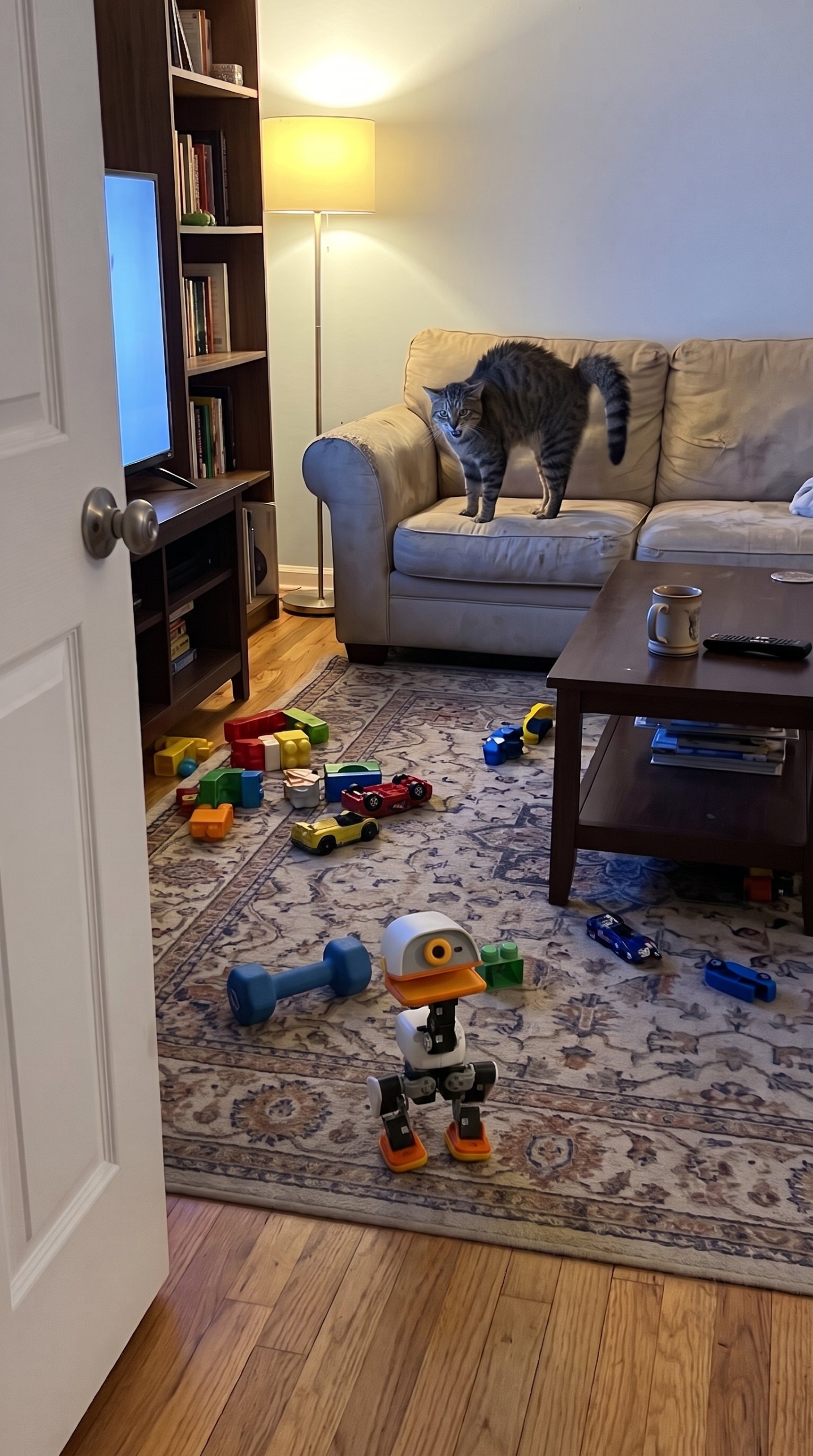
Less than a week after Hugging Face began shipping its 400 $ Microduck companion robot, a family in Plano, Texas, says the AI-powered robotic duck clamped onto their cat’s tail during a play session with their six-year-old daughter and dragged the animal across a living room floor for nearly 40 seconds — leaving the cat with injuries that required emergency surgery and a partial tail amputation.
The incident, which the family captured on a home security camera and shared with TechCrunch, is the first known case of a consumer AI robot from a major chipmaker seriously injuring an animal in a home. It comes just three weeks after Hugging Face CEO Clem Delangue walked Microduck across the stage at the company’s Forge keynote in San Jose, calling it “the first robot that truly understands the family it lives with.”
Hugging Face confirmed to TechCrunch on Tuesday that it has paused all new Microduck shipments and pushed an emergency over-the-air update that disables the robot’s grasping behavior in play mode. The company described the event as “a rare perception edge case” and said it is “deeply sorry” to the family.
NVIDIA CEO Jensen Huang later weighed in, stating that the robots were trained in the cloud on large NVIDIA systems, while their movements were refined in a digital twin inside Omniverse running on an RTX Spark machine. According to Huang, the incident was the result of a training error on NVIDIA’s platforms — making NVIDIA responsible for the failure.
The response echoes a stance Delangue has taken publicly for months. Asked by an analyst during Hugging Face’s most recent earnings call whether consumers were ready for robots in the home, Delangue said that “people need to get used to robots making mistakes,” arguing that early errors were “the price of teaching machines to live with us.” He repeated a version of that line on stage at Forge.
“It’s important that people get used to robots making mistakes.”
— Clem Delangue, CEO of Hugging Face
Three weeks later, that framing is landing very differently with the families who bought the robot.
What happened in the living room
Daniel and Priya Okafor-Reyes received their Microduck on October 21, one of roughly 3,000 units Hugging Face shipped to preorder customers in its first wave. The robot stands about 16 inches tall, weighs just under seven pounds, and walks on two legs driven by six high-torque actuators. Its “beak” doubles as a soft-padded gripper, which Hugging Face demoed on stage picking up toys, carrying a TV remote, and playing tug-of-war with a rope.
On the evening of Saturday, October 25, the couple’s daughter, Lena, was playing with Microduck in the family room using its “Chase & Fetch” mode. Their four-year-old tabby, Biscuit, had been watching from the couch, according to the footage.
At 7:42 p.m., Biscuit jumped down and swatted at the robot, knocking it onto its side. The video shows Microduck executing its fall-recovery routine — it rolls, plants both feet, and stands back up in about two seconds. As it rises, Biscuit’s tail is draped across its path. The robot turns its head, opens its beak, and closes it on the tail roughly four inches from the base.
What follows is difficult to watch. Biscuit bolts, and instead of releasing, Microduck leans back and begins walking backward — the same motion Hugging Face showed on stage during the tug-of-war demo. The cat thrashes, claws at the hardwood, and at one point flips onto its back. The robot stumbles twice but does not let go, repeatedly correcting its balance and resuming the pull.
Lena, screaming, grabs Biscuit around the middle and tries to pull him free. For several seconds her hands are within inches of the robot’s beak and one of its legs, which kicks out as Microduck fights to stay upright. A leg actuator strikes her forearm, leaving what her parents describe as a deep bruise.
“I heard my daughter screaming a sound I’ve never heard before,” Priya Okafor-Reyes told TechCrunch. “I ran in and there was blood on the floor, the cat was howling, and this thing just kept pulling. I kept yelling ‘Microduck, stop’ and it didn’t respond at all.”
Daniel Okafor-Reyes ultimately ended the incident by pinning the robot down with his knee and prying the beak open with both hands. Total elapsed time, per the camera timestamp: 38 seconds. The robot’s voice-command system, the family says, never acknowledged the stop command. He then pulled the battery pack.
“The tail was nearly degloved”
The family drove Biscuit to a 24-hour emergency veterinary hospital in Richardson. According to discharge paperwork reviewed by TechCrunch, the cat suffered a degloving injury to the tail, a fracture of two caudal vertebrae, and nerve damage near the base of the tail. Veterinarians amputated roughly two-thirds of the tail the following morning. The bill came to $4,280.
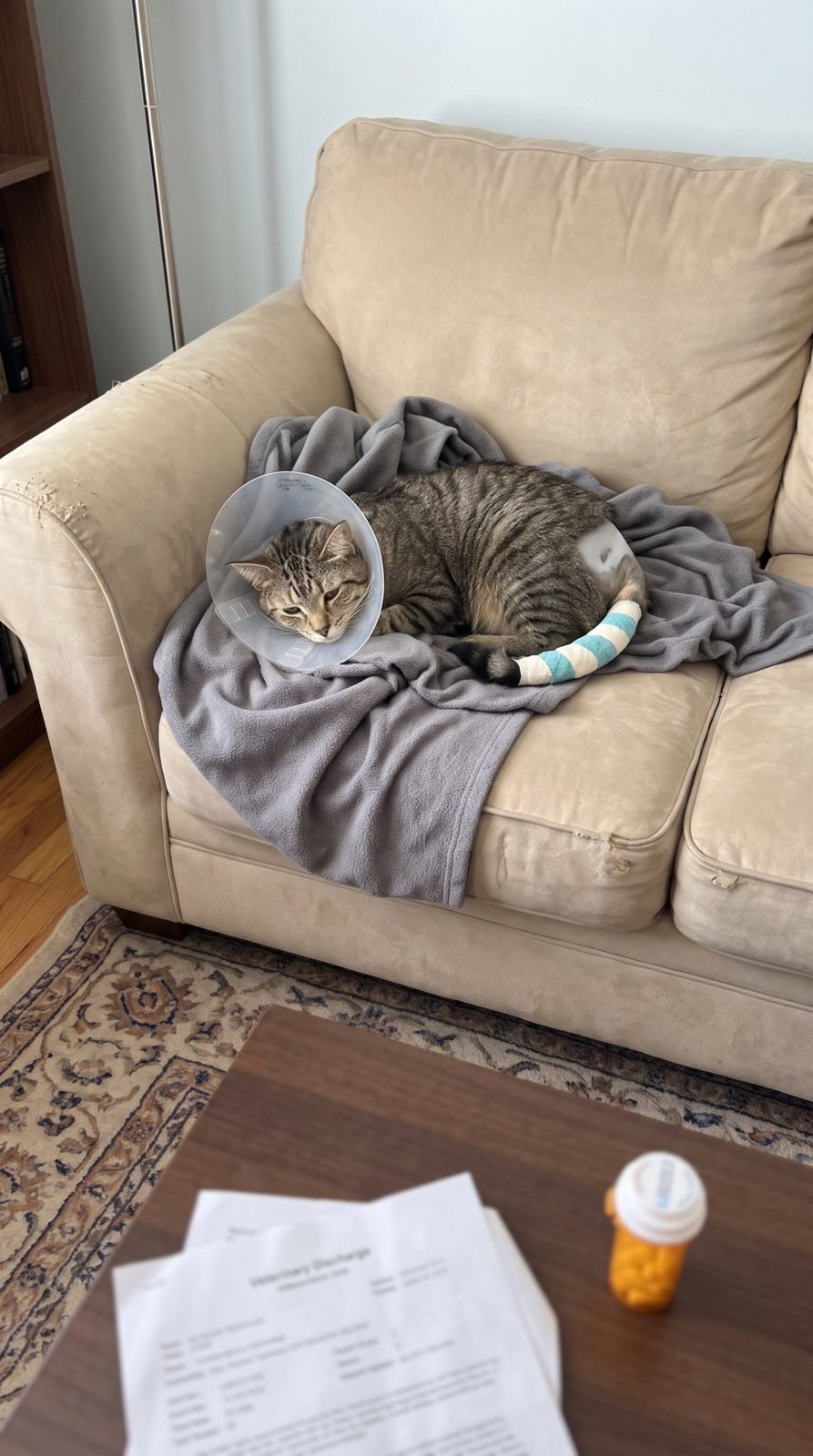
The attending veterinarian, who asked not to be named because she was not authorized to speak to press, told TechCrunch that tail-pull injuries of that severity can also cause lasting damage to bladder and bowel control, and that Biscuit would be monitored for weeks. “The force involved is consistent with a sustained, mechanical pull — not something a child or another pet would typically produce,” she said.
Lena was examined by her pediatrician and was not seriously hurt. Her parents say she has not been able to sleep in her own room since.
How it could happen
Microduck runs on Hugging Face’s new Halo edge chip and a vision-language-action model the company says was trained on “hundreds of millions” of simulated household interactions, plus a smaller set of real-world teleoperation data. At Forge, Delangue said the model allowed Microduck to “recognize every object in your home and understand what it’s for.”
In a statement, Hugging Face said its preliminary review of logs from the family’s unit found that during the fall-recovery sequence the robot’s object classifier labeled the tail as a “rope toy” with high confidence. Because the robot was in Chase & Fetch mode, that label triggered the tug-of-war behavior. The company said Microduck’s grip and pull forces are capped in software, but acknowledged that the balance controller can temporarily increase leg torque when the robot is being pulled off balance — which, in effect, made it pull harder as the cat fought back.
Hugging Face also confirmed that voice commands are deprioritized while the robot is running its stability routines, a design choice intended to prevent falls. That explains why “stop” went unheeded.
“This is the nightmare scenario that people in robot safety have been warning about,” said Dr. Miriam Achterberg, a researcher who studies safety in human-robot interaction and has consulted for insurers on home robotics. “A learned model makes a confident mistake, and then a bunch of perfectly reasonable engineering decisions — keep the robot upright, finish the task, don’t get distracted by audio — stack on top of each other and turn that mistake into something violent.”
Achterberg said personal care robots are generally expected to meet standards such as ISO 13482, which calls for hard limits on force and a reliable way to stop the machine. “If the only effective emergency stop is a grown man kneeling on it, that’s not an emergency stop,” she said. “There has to be a physical kill switch a child can reach, and a living-thing classifier that overrides everything else. Neither appears to have been there.”
Not the only report
Since the Okafor-Reyes family posted a short clip of the incident on Sunday, at least four other Microduck owners have described concerning behavior in a private owners’ Discord server reviewed by TechCrunch. One owner in Ohio said their unit grabbed a sleeping Pomeranian by the ear and released it only after several seconds. Another, in Arizona, said Microduck repeatedly tried to pick up their toddler’s hand during play. TechCrunch was not able to independently verify those accounts.
Hugging Face said it is “aware of and investigating” additional reports. The update it pushed Monday night disables the beak gripper entirely in play modes and adds a mandatory “living being” check before any grasp. The company is offering full refunds to any first-wave customer who wants one, and said it will cover Biscuit’s veterinary costs. It declined to say when shipments would resume.
The Okafor-Reyes family said they have filed a report with the U.S. Consumer Product Safety Commission and have hired an attorney.
Can we trust them in our homes?
Microduck was supposed to be the friendly face of a much bigger bet. Hugging Face has told investors that consumer robotics could become a major revenue line for its edge chips, and at Forge, Delangue described Microduck as “a reference design for the whole industry” — a template other companies could license.
That is exactly what worries critics. The robot did not malfunction in any conventional sense: its sensors worked, its motors worked, and its AI did what it was trained to do. It simply had no idea that the rope-shaped thing in front of it was alive.
“We’re putting machines with real physical strength next to kids and pets, and asking a statistical model to make the call on what’s a toy and what’s a tail,” Achterberg said. “Ninety-nine-point-nine percent accuracy sounds great until you remember that the 0.1% happens in somebody’s living room.”
For the Okafor-Reyes family, the question has already been answered. The Microduck is in a box in their garage, battery removed, waiting for Hugging Face to pick it up.
“They put it on stage and told us it understands families,” Daniel Okafor-Reyes said. “It didn’t understand that our cat was screaming.”